


Researchers with the Department of Atmospheric Science at Colorado State University are conducting a series of field campaigns to prepare for NASA’s upcoming INCUS satellite mission into weather formation.
INCUS will use three small satellites to measure vertical air motion inside storms from space. That process is key to severe weather formation, including heavy rain and damaging winds. Recent field campaigns by the Calibration and Validation team in Colorado, Alabama and Oklahoma tested weather forecasting systems in various configurations, combinations and conditions to collect information on how a storm’s vertical air motion and inner structure change over time. The pre-mission work builds understanding of severe storm dynamics and improves radar tracking algorithms ahead of launch – ensuring the unique, top-down data eventually collected by the team of satellites is accurate.
Read more on SOURCE.
The department will host a prospective student meet and greet on January 27 during the American Meteorological Society’s annual meeting in Houston. From 7:00 to 7:30 p.m. in the Hilton Americas-Houston Hotel Lanier Ballroom J, prospective students are invited to join current faculty and students to learn more about the department.
The meet and greet will be followed by the department’s reception for alumni and friends.
On January 7, the Department of Atmospheric Science will bid farewell to a truly exceptional colleague. After 17 years with the department, Manager of Business Operations Darby Nabors will retire and focus on other activities like rest, travel, and sewing. The department is deeply grateful for her dedicated service.
What began as a role in the CSU Office of Sponsored Programs in 2004 evolved into a remarkable 17-year journey with the department. Nabors herself had no idea her 2008 move to Atmospheric Science would turn into her “dream job” and the one she would hold until retirement. She has created a new standard of excellence for the position, and her dedication to the department and its mission has been evident as she helped to guide the department through challenges and change.
“Darby brought a wealth of financial and technical skills to the job. Even more important was her total dedication to our mission and her compassionate and highly effective management of department staff,” former Department Head Jeff Collett said. “ATS grew and prospered during Darby’s time as Department Manager; she deserves a lot of credit for that success.”
Beyond her financial expertise and knowledge of university systems, Nabors brought something even more critical – a warmth and generosity felt by anyone who interacted with her. Department Head Eric Maloney shared, “Darby has been the heart and soul of our department for the last decade and a half, and is irreplaceable.” University Distinguished Professor Sue van den Heever added, “Through her management and significant, long-standing contributions to the department’s financial, research project, and facility operations, Darby has left a legacy of excellence, care, and collaboration.”
Ever thoughtful of others, Nabors reflected, “I am proud to have been part of this fabulous department. The Atmos staff is my family, my tribe! They all do an amazing job and are outstanding people. I will miss them every day.”
Darby, you will be deeply missed. Thank you for your extraordinary contributions and for the care you have shown to all of us. We wish you joy and fulfillment in your next chapter.
ATS faculty, research scientists, and staff received some outstanding honors at the Walter Scott, Jr. College of Engineering all-College meeting and awards ceremony on May 6, held at the Lincoln Center in Fort Collins.
Jessie Creamean was given the Walter Scott, Jr. College of Engineering Outstanding Researcher award, to recognize outstanding research accomplishments and exceptionally dedicated service to the Department or College by a researcher.
Jim Hurrell was honored with the Art Corey Award for Outstanding International Contributions, to recognize exceptional contributions by a faculty member at the international level.
Samantha Reynolds was given the Walter Scott, Jr. College of Engineering Administrative Excellence Award, to recognize exceptional performance of a College staff member in an administrative role.
Please join us in congratulating Jessie, Jim, and Sam on these well-deserved awards! We are incredibly honored to have you as colleagues in the Department.
Each spring, the department awards the Herbert Riehl Memorial Award and the Maria Silva Dias Award to students nominated by their advisers for outstanding research. Andrey Marsavin and Allie Mazurek received the Riehl Award and the Silva Dias Award respectively this year.
The Riehl Award, named in honor of department founder Herbert Riehl, recognizes an outstanding research paper by an M.S. student or beginning Ph.D. student. Marsavin was nominated by his adviser, Professor Jeff Collett, for his first-authored paper, “Summertime ozone production at Carlsbad Caverns National Park, New Mexico: influence of oil and natural gas development,” which has been accepted subject to minor revisions at Journal of Geophysical Research: Atmospheres.
Using a photochemical box model and extensive observations of volatile organic compounds and nitrogen oxides to examine ozone production in Carlsbad Caverns National Park (CAVE), Marsavin’s research seeks to identify the source of and significant impacts on peak ozone levels in the park from the nearby Permian Basin.
“The work in his paper, and subsequent analyses he is now conducting using subsequent ground observations and satellite data to look at the evolution of ozone production and its sensitivity to regional NOx and volatile organic compounds (VOC) emissions, is drawing substantial scientific and policy interest,” Collett wrote in his nomination letter.
Silva Dias Award recipient and Ph.D. candidate Allie Mazurek was nominated by her adviser, Professor Russ Schumacher, for her research using “explainable AI” (xAI) methods to quantify what inputs the machine learning system is using to make its forecasts at each day and time, addressing the concerns about using artificial intelligence and machine learning for predictions, particularly the difficulty in understanding how algorithms are making their predictions.
Her paper on this research, “Can Ingredients-Based Forecasting be Learned? Disentangling a Random Forest’s Severe Weather Predictions,” was submitted to Weather and Forecasting in November 2023.
Schumacher noted that Mazurek’s findings “are expected to improve the confidence and trust that users can place in AI-based forecast systems, and may also yield new insights in to how the predictions can be improved in the future.”
The Silva Dias Award is given to a senior Ph.D. student in recognition of their outstanding research. Previously known as the Alumni Award, through a student-led initiative it was re-named for alumna Maria Silva Dias. Silva Dias, the department’s first woman Ph.D. graduate, received the 2017 ATS Outstanding Alum Award.
Marsavin and Mazurek were recognized at a special ceremony in April. Congratulations to both outstanding students!
Photo caption: (left panel) Professor Jeff Collett, Andrey Marsavin, and Herbert Riehl. Jr.; (right panel) Professor Russ Schumacher and Allie Mazurek.
Human activity is changing the way water flows between the Earth and atmosphere in complex ways and with likely long-lasting consequences that are hard to picture. Land use change is altering where clouds form and how precipitation is distributed. Meanwhile, weather modification activities like cloud seeding are shifting how nations plan for water use in the face of climate change. These and other changes to the planet’s atmospheric water cycle were once hard to imagine but are increasingly part of modern water management on the planet.
Colorado State University Assistant Professor Patrick Keys is an expert in climate and societal change. He has been studying these types of issues for years and realized there was a potential gap when it came to understanding – not only in the public but among the water research community – the lasting implications of these changes.
To better grasp how those kinds of activities could shape the world, he enlisted water scientists from around the globe to write story-based scenarios about the possible futures humanity is facing but perhaps can’t quite comprehend yet. The results were recently published in Global Sustainability as part of a creative pathway to understand atmospheric water research with an eye towards the potential economic and policy issues that may be just beyond the horizon.The work features striking artist-made images that pair with traditional science fiction narratives as well as alternative story forms like first-person journal entries. Keys said the package offers a wide path – grounded in science – to build a shared understanding of future water management activities and problems.
More information can be found in this article by Josh Rhoten.
Photo caption: An artist generated image illustrating possible futures in policy and research due to human modifications of the atmospheric water cycle. Credit: Fabio Comin.
A Colorado State University-led effort to study storms and extreme weather from space using small satellites passed a key review by NASA in November 2023. With that approval in hand, the team will now focus on building the satellites and instruments with industry partners in Colorado, while also developing the needed research techniques and software to accomplish its mission.
The development marks an important milestone for the $177 million at selection Investigation of Convective Updrafts mission known as INCUS. The project aims to understand when, where and why tropical convective storms form and why only some of them produce extreme weather like heavy rain and strong wind. Key to those questions is the role of the vertical transportation of air and water in those types of storms – an aspect that is currently not well understood or easy to represent in forecasts and modeling. The INCUS mission addresses that need directly by using multiple satellites orbiting the planet to provide a sequential, top-down view of the dynamics within storms and how they change.
The move from the design stage to the construction stage of the instruments, spacecraft and mission systems sets up a launch that will occur no later than 2027, said Principal Investigator Sue van den Heever, a University Distinguished Professor in the Department of Atmospheric Science.
More information can be found in this article by Josh Rhoten.
It is a pleasure to announce Dr. Dien Wu will be joining our department as an Assistant Professor in January 2025. Dr. Wu (http://dienwu.me) will be coming here as a culmination of our recent surface-atmosphere interaction faculty search.
Currently a scientist in the Division of Geological and Planetary Sciences at Cal Tech, Dr. Wu received her Ph.D. in Atmospheric Sciences from the University of Utah in 2020. She seeks to quantify human impacts on carbon, water, and energy fluxes over climate-sensitive regions using unique remote sensing and modeling techniques. Dr. Wu’s areas of interest include the urban carbon cycle, assessing the impact of irrigation on carbon and water fluxes, examining the impact of prescribed burns on emissions and local ecosystems, and exploring the complexities of interactions at urban-wildland and urban-agriculture interfaces, among other topics. She also has many exciting teaching plans related to such topics.
Dien, welcome to our department. We are excited for your arrival!
A delayed congratulations to several ATS students who received awards from the American Meteorological Society at their annual meeting and chapter conferences earlier this year!
- Kimberley Corwin – AMS first place Oral Presentation Award for her talk “Three Views of the Impact of Local and Transported Wildfire Smoke on U.S. Solar Energy Resource Availability.”
- Allie Mazurek – AMS second-place Best Student Oral Presentation for her talk “Using Tree Interpreter to Disaggregate a Random Forest’s Severe Weather Predictions” at the 23rd Conference on Artificial Intelligence for Environmental Science and AMS second-place Student Oral Presentation for her talk “When Do Machine Learning Forecasts Succeed and Fail? Evaluating Synoptic Regimes Associated With a Random Forest’s Good and Bad Severe Weather Predictions” at the 14th Conference on the Transition of Research to Operations.
- Christine Neumaier – AMS/NWA second-place Outstanding Student Presentation Award for the 2024 High Plains AMS/NWA Conference.
- Angelie Nieves Jiménez – AMS first-place Best Student Oral Presentation Award for her talk “Extreme Rainfall and Intensification Mechanisms in Hurricane Fiona (2022)” at the Sixth Special Symposium on Tropical Meteorology and Tropical Cyclones.
- Olivia Sablan – AMS Outstanding Student Oral Presentation Award for her talk “Quantifying smoke from sugarcane burning in Florida during the 2022-2023 season” at the 26th Conference on Atmospheric Chemistry.
- Kevin Yang – AMS Best Student Presentation Award for his talk “Quantifying Near-Cloud Aerosol Properties and Radiative Effects across Various Cloud Organizations Using Machine-Learning Techniques,” at the 16th Symposium on Aerosol Cloud Climate Interactions.
Congratulations again! The department is proud of all of its students.
Photo caption (from left to right, top to bottom row): Kimberley Corwin, Allie Mazurek, Christine Neumaier, Angelie Nieves Jiménez, Olivia Sablan, and Kevin Yang.
Colorado State University hurricane researchers are predicting an extremely active Atlantic hurricane season in their initial 2024 forecast. The team cites record warm tropical and eastern subtropical Atlantic sea surface temperatures as a primary factor for their prediction of 11 hurricanes this year.
When waters in the eastern and central tropical and subtropical Atlantic are much warmer than normal in the spring, it tends to force a weaker subtropical high and associated weaker winds blowing across the tropical Atlantic. These conditions will likely lead to a continuation of well above-average water temperatures in the tropical Atlantic for the peak of the 2024 Atlantic hurricane season. A very warm Atlantic favors an above-average season, since a hurricane’s fuel source is warm ocean water. In addition, a warm Atlantic leads to lower atmospheric pressure and a more unstable atmosphere. Both conditions favor hurricanes.
While the tropical Pacific is currently characterized by El Niño conditions, these are likely to transition to La Niña conditions by the peak of the Atlantic hurricane season from August to October. La Niña tends to decrease upper-level westerly winds across the Caribbean into the tropical Atlantic. These decreased upper-level winds result in reduced vertical wind shear, favoring Atlantic hurricane formation and intensification.
More information on how the forecast was generated and implications for the coming season can be found in this Source article, written by Josh Rhoten.
We are excited to announce that Professor and former Department Head Jeff Collett was named University Distinguished Professor (UDP). UDP is the highest academic recognition awarded by the University, and the title of UDP is bestowed upon full professors on the basis of outstanding scholarship and achievement. Professors receiving this title hold the distinction for the duration of their association with Colorado State University. As of last year, there were 22 UDPs and 31 emeritus UDPs across 27 academic departments.
Jeff was nominated for being a leader in understanding critical environmental issues including air quality, his distinguished service to the university and broader scientific community, and his commitment to mentorship and education. He will join Sonia Kreidenweis, Dave Randall, A. R. Ravishankara, and Sue van den Heever as UDPs in our department, and Graeme Stephens and Tom Vonder Haar as Emeritus UDPs.
Jeff will receive this honor at the Provost’s Awards Luncheon on April 10.
More on Jeff’s accomplishments as described by Provost Marion K. Underwood can be found in this Source article. Congratulations Jeff. We couldn’t be prouder to have you as a colleague!
The National Academy of Engineering is adding University Distinguished Professor, ATS Faculty member, and CIRA Fellow Sonia Kreidenweis as a new member for 2024. Election to the body is among the highest professional distinctions accorded to an engineer. Membership honors those who have made outstanding contributions to engineering research, practice, or education. Sonia was cited “For elucidating the impact of aerosols on climate, linking chemical composition and cloud formation capacity.” More on Sonia’s election and accomplishments can be found in this Source article, which also honors the election of University Distinguished Professor Jorge Rocca in ECE to the academy. Congratulations Sonia!
The third edition of the Climate Change in Colorado report was published on Jan. 8, 2024. Created by ATS researchers at Colorado State University, the new multi-chapter report combines and synthesizes relevant climate science information to help inform future management and planning of the state’s water resources.
Previous editions of the report in 2008 and 2014 were among the first state-level climate change assessments ever conducted in the U.S. The new report was created by researchers at CSU in the Department of Atmospheric Science within in the Walter Scott, Jr. College of Engineering. Funding and support came from the Colorado Water Conservation Board and Denver Water.
The new Climate Change in Colorado report combines and synthesizes relevant climate science information to help inform future management of the state’s water resources. CSU Research Scientist Becky Bolinger served as the lead author for the report and is the assistant state climatologist for Colorado. She said the report describes trends in Colorado’s climate and hydrology, interprets model-based projections for the future, and considers potential hazards stemming from changes in climate. It also verifies projections found in earlier reports and updates them to extend out through 2050 and beyond.
More detail can be found in a CSU Source Article written by Josh Rhoten.
Article modified from a version written by CSU MarComm Staff.
The CSU Department of Atmospheric Science will be hosting a virtual meet & greet for prospective students on January 16, 2024, at 3:00 pm (MT). If you are considering our department for graduate school, please plan to join us for this special event where you will be able to chat with faculty and current students to hear firsthand about the research experience at our department. You will also have the opportunity to ask any questions you may have about the application and department in general. Check out the full-size invitation and announcement here, and please RSVP for this event here.
The CSU Department of Atmospheric Science will host a reception for alumni, faculty, students, and friends at the 104th American Meteorological Society Annual Meeting in Baltimore, Maryland. This reception will occur on Tuesday, January 30, 2024, at 7:30 pm in the Key Ballroom Salon 3-4 of the Hilton Baltimore Inner Harbor. There will also be a meet and greet with ATS faculty for prospective students in the same space from 7-7:30 pm. Check out the full-size invitation and announcement here.
The department celebrated fall graduates (and those who defended earlier this semester) at a ceremony on December 7, 2023. Advisers shared information about each graduate, and family and friends were able to attend.
We asked our graduating students about their plans following graduation and the most important thing they learned at CSU. Here are their responses.
Emily Gordon
“Postdoc at Stanford University.”
“The most transformative thing I learned at CSU was the cultivation and refinement of my research skills and instincts.”
Zaibeth Carlo-Frontera
“Teaching at a STEAM School.”
“How to conduct good and reliable science while learning and discovering new and fascinating things!”
Amanda Bowden
“University of Colorado at Boulder.”
“When opportunity presents itself, don’t be afraid to go after it.”
Andrey Marsavin
“I’m staying at CSU for the Ph.D.!”
“It’s OK to sometimes feel like you are working in circles. Those moments are not a waste of time but rather opportunities for growth and learning.”
Julieta Juncosa Calahorrano
“University of Minnesota.”
“I was always amazed by the Atmos department’s capacity to NOT shy away from problems/challenges. I was surprised mainly by how faculty, staff, and students would take immediate action to find ways (and work hard!) to improve those and provide a better space for everyone. I am committed to bringing this lesson to wherever I end up working.”
Emily Lill
“Continuing onto ATS Ph.D. program.”
“How to work in extreme temperatures :).”
En Li
“Staying for Ph.D.”
“It takes a village.”
Olivia Sablan
“Staying at CSU for my Ph.D.!”
“I learned how to better communicate my work with different audiences.”
James Larson
“I’ll be staying in the Atmospheric Science department for a Ph.D., the great people, and the good skiing.”
“I learned how important is a holistic support system: great friends, family, and mentors make it all possible.”
Ryan Patnaude
“Staying at CSU for Post doc.”
“The work never ends.”
Kevin Barry
“Staying in the department as a Postdoc.”
“Work hard, but don’t take yourself too seriously. There’s always time to do the right thing.”
Kathryn Moore
“TBD.”
“The importance of occasionally saying ‘no’ and being able to prioritize yourself.”
Kyle Hilburn
“CIRA.”
“Never stop asking questions.”
Ann Casey Hughes
“Staying on for a Ph.D.!”
“Focus on what you can control of and take it one day at a time.”
Lexi Sherman
“I am continuing my education at CSU and will be pursuing my Ph.D.!”
“I learned the importance of continued self-growth. Developing new skills, experiencing new things, and pushing myself outside my bubble have helped me build my confidence as well as become a better student and person.”
Zoe Douglas
“I am staying at CSU to work toward my Ph.D.”
“Be patient with yourself as you learn how to become a more effective researcher and science communicator; you don’t have to know everything from the very first day. The students, faculty, and staff are always willing to help as long as you aren’t afraid to ask!”
Eric James
“NOAA Global Systems Laboratory.”
“Data assimilation theory, and how different algorithms work practically.”
Christine Neumaier
“I am staying at CSU to do my Ph.D.!”
“The most important thing I’ve learned is how to collaborate and ask for help.”
Photo collage, from left to right, top to bottom row: Ben Ascher, Jack Cahill, En Li, Lexi Sherman, Zaibeth Carlo-Frontera, Kyle Hilburn, Julieta Juncosa Calahorrano, Andrey Marsavin, Kevin Barry, Christine Neumaier, Amanda Bowden, Emily Lill, Zoe Douglas, Ann Casey Hughes, Emily Gordon, James Larson, Olivia Sablan, Eric James, Kathryn Moore, Ryan Patnaude.
Fall 2023 Graduates
| Ben Ascher * | M.S. | Adviser: Sue van den Heever |
| Kevin Barry * | Ph.D. | Advisers: Sonia Kreidenweis and Paul DeMott |
| Amanda Bowden | M.S. | Adviser: Eric Maloney |
| Jack Cahill | M.S. | Advisers: Libby Barnes and Eric Maloney |
| Zaibeth Carlo-Frontera * | M.S. | Advisers: Libby Barnes and Eric Maloney |
| Zoe Douglas * | M.S. | Adviser: Kristen Rasmussen |
| Emily Gordon | Ph.D. | Adviser: Libby Barnes |
| Kyle Hilburn | Ph.D. | Adviser: Steve Miller |
| Ann Casey Hughes | M.S. | Adviser: Dave Randall |
| Eric James | Ph.D. | Adviser: Russ Schumacher |
| Julieta Juncosa Calahorrano * | Ph.D. | Adviser: Emily Fischer |
| James Larson * | M.S. | Advisers: Jim Hurrell and Dave Thompson |
| En Li | M.S. | Advisers: Jeff Pierce and Emily Fischer |
| Emily Lill * | M.S. | Advisers: Emily Fischer and Jessie Creamean |
| Andrey Marsavin | M.S. | Adviser: Jeff Collett |
| Kathryn Moore | Ph.D. | Advisers: Sonia Kreidenweis and Paul DeMott |
| Christine Neumaier | Ph.D. | Adviser: Sue van den Heever |
| Ryan Patnaude | M.S. | Advisers: Sonia Kreidenweis and Paul DeMott |
| Olivia Sablan | Ph.D. | Advisers: Jeff Pierce and Emily Fischer |
| Lexi Sherman | M.S. | Adviser: Kristen Rasmussen |
* Completed defense before December 7 but technically will graduate spring semester
The 2023 recipients of the David L. Dietrich Honorary Scholarship and the Shrake-Culler Scholarship were announced at the department’s fall graduate and awards recognition event on December 7. Sam O’Donnell received the Dietrich Scholarship, and the Shrake-Culler Scholarship was awarded to Allie Mazurek.
The Dietrich Scholarship, funded by Fort Collins-based Air Resource Specialists Inc., is presented to students who have demonstrated outstanding research in air quality. ARS President Jessica Ward and Vice President Genevieve Lariviere were both in attendance.
O’Donnell was nominated by his adviser Jeff Pierce, who presented the award virtually. Pierce described O’Donnell’s research impacts, including a manuscript in progress on using 3D modelling to understand the overlooked role of airmass advection in biasing observations from stationary sites. O’Donnell gave a brief presentation on this research. In addition to his research, Pierce emphasized that O’Donnell is “very hardworking, humble, and helpful.” O’Donnell is always ready to help, and he “views issues in the Atmospheric Science field as bigger than himself but wants to be part of solutions.”
The Shrake-Culler Scholarship is given annually to a senior Ph.D. student who has passed their preliminary exam, has a GPA of 3.5 or above, and has demonstrated a strong work ethic and enthusiasm for higher education.
Russ Schumacher presented the Shrake-Culler Scholarship to Mazurek, describing how she ensures that her work is as good as it can be and strives to help others succeed. “[Mazurek] has been a leader in our research group, the department, and the broader scientific community, demonstrating her enthusiasm for higher education,” Schumacher said. Mazurek gave a presentation on her Ph.D. work centered around identifying what artificial intelligence and machine learning systems use to create severe weather forecasts.
Congratulations, Sam and Allie!
Photo caption: (left panel) ARS President Jessica Ward, Sam O’Donnell, and ARS Vice President Genevieve Lariviere; (right panel) Allie Mazurek and her Ph.D. adviser Russ Schumacher.
ATS faculty member Jeff Pierce recently contributed to the 5th National Climate Assessment, a national report meant to inform decision making. Jeff contributed to the air quality chapter, and shared insights into how climate change may affect air quality, including through increased wildfire activity and associated smoke. A Source story written by Jayme DeLoss on CSU contributions to the National Climate Assessment can found here.
Photo caption: Solar panels at the National Renewable Energy Laboratory in Golden, Colorado. Credit: Werner Slocum/NREL.
Our department was well-represented in recent elections of the National Weather Association (NWA). ATS M.S. graduate Becca Mazur was chosen as President-elect/Board Director. She will begin a term on January 1, 2024, and assume the role of President in 2025. Becca received her M.S. degree from the department in 2007 under the guidance of Professor Tom Vonder Haar. Becca’s thesis was entitled “Observations of inflow feeder clouds and their relation to severe thunderstorms.” Current ATS graduate student Katurah McCants was elected director for the year 2024. Advised by ATS Professor and CIRA Director Steve Miller and mentored by John Haynes, Katurah is working on anticipating the capabilities/limitations of the forthcoming GeoXO 0.91 micron shortwave vapor band. Congratulations to both Katurah and Becca! The NWA is a professional association supporting and promoting excellence in operational meteorology and related activities.
Photo caption: Katurah McCants (left) and Becca Mazur (right).
Justin Hudson, Ph.D. candidate advised by Steve Miller, received a scholarship award from the Graduate Student Council at the 2023 Graduate Student Showcase. The showcase was held on November 15.
The Graduate Student Council, one of many sponsors of the showcase, selected five graduate students to receive their scholarship. Hudson was selected for his project focused on milky seas, a rare form of large-scale bioluminescence where the ocean can glow for days to months at a time over areas up to 100,000+ km2. Milky seas “represent a unique interaction between the atmosphere, ocean, and biosphere,” Hudson explained. “Using a simple model based on known air-sea-biosphere interactions, a milky sea was successfully predicted for the first time. This represents a crucial first step towards eventually being able to study milky seas in person and understanding what causes them,” he said.
Hudson said that participating in the showcase was a great experience overall, and that he “personally got a lot out of presenting [his] work and chatting with people in other departments.” He added that it would be a great experience for ATS students in the future.
Congratulations, Justin!
We are excited to announce that Prof. Maria Rugenstein has been awarded the 2024 Outstanding Early Career Scientist Award by the Climate: Past, Present & Future Division of the European Geosciences Union. This award recognizes Maria for her important contributions to the Earth sciences in the area of climate. Maria has contributed fundamental and widely recognized research on understanding climate sensitivity and feedbacks, including the role of SST pattern changes for understanding the future climate response to greenhouse gas forcing. This award will be celebrated during the 2024 EGU General Assembly, which will be held from 14–19 April in Vienna, Austria. The full list of individuals recognized by EGU can be found here: https://www.egu.eu/news/987/egu-announces-its-2024-awards-and-medals/
Congratulations Maria! This is well-deserved.
The U.S. Department of Energy has awarded Russel Perkins, a research scientist in CSU’s Department of Atmospheric Science, funding to advance our understanding and modeling of the role that a class of atmospheric aerosols known as ice-nucleating particles play in cloud formation. Perkins and co-investigator Sonia Kreidenweis, a University Distinguished Professor of Atmospheric Science, will investigate how different aerosols affect cloud properties like ice/water ratio, average droplet size, and other factors. More information about this award and the research being funded can be found in the following Source article written by Rich Young: https://engr.source.colostate.edu/csu-researcher-wins-doe-funding-to-improve-modeling-of-atmospheric-ice-nucleation/
Graduate student Alex DesRosiers was honored on November 3 as the first recipient of the William M. Gray Award, a newly established honor that recognizes outstanding published research into fundamental tropical meteorology and climate. Alex received the award at a special department event and presented his recognized research. He is a Ph.D. candidate advised by Michael Bell entering the final year of his research, which involves the vertical structure of tropical cyclones and how that relates to their intensity as well as their intensification rate. Sarah and Janet Gray attended the ceremony, where Bill Gray’s legacy in tropical meteorology research and contributions to the department were also discussed. Congratulations Alex! More details on the event and Prof. Gray can be found in a Source article written by Josh Roten: https://engr.source.colostate.edu/new-student-scholarship-award-honors-bill-grays-contribution-to-atmospheric-science/
We Are Water, an NSF-funded project focused on water issues in the Four Corners Region, received an 2023 Governor’s Award for High-Impact Research earlier in October. The Community Collaborative Rain, Hail and Snow Network (known as CoCoRaHS) is a partner on the project.
Water is an incredibly important, complicated topic in the Four Corners Region. We Are Water was started with the hope of providing community members with a place to discuss and understand the many water issues affecting this region. Through a collaboration between CIRES Education & Outreach, Western Water Assessment, Indigenous education organizations, local libraries, and climate scientists, We Are Water created a traveling exhibit for rural libraries to host at their locations for two to three months at a time. The exhibit highlights different themes tying water with life, landscape, community – all shared through hands-on activities or games.
“It’s been one of the most professionally satisfying projects CoCoRaHS has been a part of,” Noah Newman, education and outreach coordinator for CoCoRaHS, said. Newman attended the awards ceremony at the Denver Museum of Nature and Science on October 11. “I’ve learned so much about collaborating with different groups and the sharing of knowledge, but getting to interact and learn from the community members themselves has been the best part of it all.”
Photo caption: We Are Water team accepts their Governor’s Award; CoCoRaHS Education and Outreach Coordinator Noah Newman (fourth from right) attended. Photo by Stephanie Maltarich.
Lilly Naimie won the Best PhD Student Oral Presentation Award at last week’s National Atmospheric Deposition Program (NADP) Scientific Symposium held in Madison, Wisconsin, October 25-26. Lilly’s presentation was entitled “Contributions of Ammonia Dry Deposition to Excess Nitrogen Deposition in Rocky Mountain National Park.” Lilly is advised by Jeff Collett.
Started in 1977, NADP was created to measure atmospheric deposition and study its effects on the environment. Today, the program is a “a cooperative effort between many different groups, including federal, state, tribal and local governmental agencies, educational institutions, private companies, and non-governmental agencies.” It is housed at the University of Wisconsin-Madison and now has about 356 different site locations with more than 37,000 users.
ATS graduate student Jamin Rader’s Ph.D research that applies machine learning to climate prediction was featured by DOE in the 2023 edition of the Computational Science Graduate Fellowship Program DEIXIS magazine. The article follows the arc from Jamin’s early interest in weather to his recent work using ML to explore predictability in weather and climate. The article highlights the power of interpretable AI for climate research, which Jamin says “comes from the idea that we can make neural networks think a little bit like us.” The piece describes Jamin’s success in applying interpretable ML to understand preconditions for the formation of El Niño. The entire DEIXIS volume can be found here: https://www.krellinst.org/doecsgf/docs/deixis/deixis2023.pdf.
The Colorado Sun wrote an article on ATS graduate student Angelie Nieves Jiménez, who recently flew on a NOAA Hurricane Hunter mission into Hurricane Franklin. The story recounts Angelie’s experiences during her undergraduate studies in Puerto Rico, when a major hurricane devastated the island and severely affected the health and livelihoods of her family and friends. The article also discusses the motivation she gained from this experience to help make better hurricane predictions, which she is now doing as a student in ATS under the advising of Prof. Michael Bell. The link to the Colorado Sun article can be found here: https://coloradosun.com/2023/10/13/a-csu-grad-student-flew-into-a-hurricane/
It was announced on September 13 that Prof. Sonia Kreidenweis has been recognized with the Yorum J. Kaufman Outstanding Research and Unselfish Cooperation Award by the Atmospheric Sciences section of the American Geophysical Union. According to AGU, this award is presented yearly to recognize a senior scientist’s broad influence in atmospheric science. “Notable contributions can include the awardee’s exceptional creativity, inspiration of younger scientists, mentoring, international collaborations, and unselfish cooperation in research.” This award was established in 2008 in honor of Yoram J. Kaufman, a researcher who served as a mentor and devoted his career to international collaborations on atmospheric aerosols that influence the climate. The award will be presented at the atmospheric science section dinner at the upcoming Fall AGU meeting in San Francisco. Congratulations Sonia!
The Department of Atmospheric Science at Colorado State University has announced an opening for a tenure-track faculty position at the assistant professor level. We solicit candidates in the research area of surface-atmosphere interactions. Areas of interest include, but are not limited to, land-atmosphere interactions, atmospheric boundary layer, carbon cycle, and cryosphere-atmosphere interactions. Applications are requested by October 31, 2023.
The job posting is here: https://jobs.colostate.edu/postings/133124
A study led by CSU climatologist Peter Goble, who is based in the Colorado Climate Center and ATS, showed that climate conditions that enable grapes to thrive in Palisade also exist in other parts of Western Colorado and near Cañon City. This could lead to expansion of the state’s wine industry according to the article published in Journal of Applied and Service Climatology. More details can be found in a CSU Source article written by Emily Wilmsen, which can be found here.
Photo caption: Horst Caspari, viticulture professor at CSU’s Western Colorado Research Center.
The Atmospheric Science graduate representatives selected Professor Chris Kummerow as the Professor of the Year, an award announced during the New Student Welcome Picnic at Spring Canyon Park on September 5. Graduate Representative Angelie Nieves Jiménez announced the honor. The awardee is selected based on the individual who received the strongest feedback for teaching excellence on student course evaluations.
The graduate representatives shared some of the praise for Chris’s teaching of ATS 652 Atmospheric Remote Sensing:
“Chris’s teaching ability is incredible and his classroom engagement is unparalleled. Despite having an extremely busy schedule, he always takes time with his students and is happy to give a listening ear.”
“[Chris] explains complex topics like scattering of electromagnetic radiation with a strong focus on physical principles, which makes them easier to understand.”
“Dr. Kummerow’s lectures usually make complicated things simple and easy to understand with enough details and in-depth insights, even though this course is the first atmospheric course I have taken.”
Students also commented on Chris’s efforts to instill the importance of work-life balance in their careers.
Congratulations to Chris on this accomplishment!
The American Meteorological Society announced this week the recipients of its 2024 awards and honors. The recipients include several current and recent members of the department.
Professors A.R. Ravishankara and David Thompson were named as Fellows of the AMS. The nomination is open to all 13,000 or so AMS members, and a select few are elected as new fellows each year by the Society’s governing body. AMS Fellows have made outstanding contributions to the atmospheric or related oceanic or hydrologic sciences or their applications during a substantial period of years.
Professor Christine Chiu was awarded the David and Lucille Atlas Remote Sensing Prize. This prize is given biennially in recognition of advances in the science and technology of remote sensing and its application to knowledge of the earth, oceans, and atmosphere.
Professor Dave Randall was selected for the Warren Washington Research and Leadership Medal. The Medal honors the recipient’s outstanding research and leadership in the science of modeling weather and climate, with an emphasis on the role of clouds.
Randy Chase, research scientist with CIRA and Professor Sue van den Heever’s group, and Aaron Hill, recent research scientist with Professor Russ Schumacher’s group, were named AMS editor’s award winners. Hill recently began an assistant professor position with the University of Oklahoma.
Alumnus Mark DeMaria (M.S. 1979, Ph.D. 1983), a CIRA Fellow and senior research scientist, received the Banner I. Miller award for contributions related to understanding rapid TC intensifications. DeMaria was named an AMS Fellow last year.
All of this year’s recipients will be recognized at the 104th AMS Annual Meeting in Baltimore in January 2024.
Photo caption (left to right): A. R. Ravishankara, David Thompson, Christine Chiu, David Randall, Randy Chase, Aaron Hill, and Mark DeMaria.
Some of the Department’s innovative research using artificial intelligence (AI) to tackle complex problems in weather and climate was featured in a recent Source article by Jayme DeLoss. In particular, the article highlights the work being done in the research teams led by Professors Elizabeth Barnes and Russ Schumacher using machine learning to gain insights into the inner-workings and prediction of climate and weather. The article also features work by ATS graduate student Allie Mazurek and former CSU research scientist Aaron Hill, as well as CIRA scientist Imme Ebert-Uphoff. More information can be found here: https://source.colostate.edu/how-can-ai-help-in-climate-change/
The Colorado Climate Center organized the Colorado Climate Services Summit, held August 8-9 at the CSU Spur campus in Denver. The goal of the summit was to bring together providers and users of climate services to build partnerships and relationships, communicate existing tools and products, and identify new opportunities. Participants included the National Weather Service, U.S. Forest Service and National Oceanic and Atmospheric Administration. More details can be found in a Source article, including discussion on Colorado climate from Assistant State Climatologist Becky Bolinger and State Climatologist and Atmospheric Science faculty member, Russ Schumacher.
Colorado State University researchers are partners in a project that could revolutionize our ability to observe, understand and ultimately predict high-impact weather events. The National Science Foundation has awarded $91.8 million in funding for a next-generation airborne radar designed by the National Center for Atmospheric Research, and CSU will contribute to the radar’s research and development. Atmospheric Science Professor Michael Bell is a co-investigator on this effort. This work is described in more detail in a CSU Source article written by Jayme DeLoss, linked here.
Photo caption: The NSF/NCAR C-130 sits in its hangar at the Research Aviation Facility in Broomfield. NCAR’s new Airborne Phased Array Radar (APAR) will be mounted on this C-130 and made available to the university research community. Credit: UCAR
ATS faculty members Elizabeth Barnes and Patrick Keys were involved in a study that sheds new light on how quickly Earth’s temperature moderates in response to dramatic cuts in greenhouse gas emissions. Earth’s global temperatures would need at least a decade to stabilize after the entire globe cuts carbon emissions to zero, according to new research that involves Colorado State University’s world-renowned atmospheric scientists. This work is described in more detail in a CSU Source article written by Emily Wilmsen, linked here.
Jayme DeLoss asked Atmospheric Science Professor Jeff Pierce, an atmospheric chemist who studies air pollution and health, a few questions about the health implications of breathing wildfire smoke and resources that can help keep people safe. The CSU SOURCE article with this interview can be found here.
CSU’s Department of Atmospheric Science welcomed a new class of summer interns this week. Through a National Science Foundation grant, the REU Site in Earth System Science offers paid summer undergraduate research internships in the department, where the students join world-class atmospheric scientists investigating clouds, climate, weather, and modeling. The Research Experiences for Undergraduates (REU) program also gives interns the opportunity to attend scientific seminars, visit national laboratories and participate in professional development training. The program spans 10 weeks from late May through early August.
Front row (Left to right): Bailey Kropp, Debanajali Pathak, Juliette Rocha. Back Row (Left to Right): Alyssa Belanger, Doug Falter, James Miezejeski, Mitchell Green.
Five current and incoming students have received prestigious graduate fellowships. Current student Angelie Nieves Jiménez and incoming students Delián Colón Borgos, Killian McSweeney, and Nick Mesa have received National Science Foundation Graduate Research Fellowships (NSF GRFP). Current student Amanda Bowden was awarded the Department of Energy Computational Science Graduate Fellowship (DOE CSGF).
The NSF Graduate Research Fellowship Program recognizes and supports outstanding graduate students in STEM disciplines who are pursuing research-based master’s and doctoral degrees at accredited U.S. institutions. The five-year fellowship includes three years of financial support.
Nieves Jiménez proposed modeling rapidly intensifying tropical cyclones in environments where the dynamics that affect rainfall location can be modified. Her drive to study tropical cyclones stems from a desire to give back to the community and the island of Puerto Rico where she grew up. During her first year in the master’s program, her work focused on analyzing a devastating hurricane that made landfall in Puerto Rico, with rainfall being the major impact.
“This award allows me to continue this research and my studies in this area while also gaining field experience and collaborating with renowned scientists,” said Nieves Jiménez. “Receiving this award would not have been possible without the support of my advisor Dr. Michael M. Bell, and my mentors, Dr. Rosimar Rios-Berríos and Dr. Joshua J. Alland. I particularly want to extend my gratitude to my Mom, Dad, brother, and friends, who constantly support and reassure me, from Puerto Rico.”
Incoming student Colón Burgos is also from Puerto Rico and wanted her proposal to directly support research on the threats the island faces from the rainfall of tropical cyclones. The impacts of inland flooding can be very localized and difficult to predict due to the varying topography of islands, and the goal of her proposal is to better the interactions that take place between Puerto Rican topography and tropical cyclones at landfall. Colón Burgos said, “This includes understanding the dynamics and thermodynamic processes of how the topography and surface enthalpy fluxes in the island of PR influence the structure of TCs from observations and model output; and examining how these changes in structure modulate the rainfall in the island.”
Colón Burgos will be advised by Bell and will work with him to design a project inclusive of her proposal as well as the Bell research group’s goals. She has deferred her NSF GRFP for a year so that she can receive a Walter Scott, Jr. Graduate Research Assistantship.
McSweeney, also starting in the master’s program this fall, submitted a research proposal focused on better understanding the relationship between snow cover extent, the timing of snow melt, and the circulation in the Arctic atmosphere in the following summer. His proposal was also interested in understanding how a large ensemble of global climate models compares to observations/reanalysis data in representing this.
“My preliminary results relied primarily on understanding the change to the vertical temperature gradient between 700 [hPa] and 850 [hPa] from the ‘present’ period of 2000-2020 to the ‘future’ of 2080-2100,” McSweeney explained. “There was introductory evidence linking snow cover change to these vertical temperature gradient changes, which is a promising start for trying to understand the influence of snow cover on the following summer’s Arctic atmospheric circulation.”
McSweeney earned a BS in Atmospheric Science from the University of Georgia-Athens and will join Maria Rugenstein’s group.
Mesa wants to tackle two critical challenges in the field of tropical meteorology with his NSF GRFP proposal: how do tropical cyclones (TCs) overcome moderate vertical wind shear to intensify, and how can we resolve the gaps in temporally and spatially varying observations of TCs? To answer these questions, his proposal sought to compile near-coincident observations from various instruments to conduct a novel, multi-scale, composite analysis of TCs facing moderate vertical wind shear. Multiple diagnostic products were proposed to be derived from these near-coincident observations to determine patterns such as trends in mid-level relative humidity in the upshear quadrants of the storm and the distribution of different types of convection. “This proposal served as a continuation of my work as a NOAA William M. Lapenta Scholar with the Hurricane Research Division in 2021, where I worked with Drs. Robert Rogers and Jonathan Zawislak.”
Mesa will join Michael Bell’s group this fall and has also chosen to defer his NSF GRFP to accept an American Meteorological Society Graduate Fellowship for his first year. In the future, his GRFP funding will help support “my research and collaboration on this topic with scientists from CSU, CIRA, CIMAS at the University of Miami, and the Hurricane Research Division,” Mesa said. He received a BS in Atmospheric Science from the University of Florida.
Bowden was awarded the DOE CSGF. Per the official press release announcing the 2023-24 class, this fellowship provides outstanding benefits and opportunities renewable up to 4 years to students pursuing doctoral degrees in fields that use high-performance computing to solve complex science and engineering problems. Bowden and her cohort will also have the opportunity to intern at any DOE laboratory during their fellowships. Bowden is currently advised by Eric Maloney but will work on her proposed doctoral research at the University of Colorado at Boulder under the guidance of Dr. Kris Karnauskas. She will be co-advised by Maloney.
Bowden’s proposed research is to evaluate how Madden-Julian Oscillation (MJO) activity change in a future climate impacts atmospheric rivers (ARs) and tropical cyclones (TCs) using Community Earth System Model 2 (CESM2). The MJO becoming stronger in a warmer environment could result in stronger enhanced and suppressed phases, which causes its modulation of ARs and TCs to become stronger, as well as its impact on vulnerable communities . Areas of interest include the societal impacts on tropical islands and coastline communities, which are vulnerable communities to the effects of climate change and intense storms.
Congratulations to all fellowship recipients!
Photos from left to right: Angelie Nieves Jiménez, Delián Colón Borgos, Killian McSweeney, Nick Mesa, Amanda Bowden.
The department celebrated fall graduates at a ceremony on December 2, 2022, and spring and summer graduates on May 12, 2023. Advisers shared information about each graduate, and family and friends were able to attend.
We asked our graduating students about their plans following graduation and the most important thing they learned at CSU. Here are their responses.
Tyler Barbero
“I am continuing on for the PhD here at CSU!”
“The most important thing I’ve learned is to have confidence in myself!”
Ting-Yu Cha
“I will be going to NCAR in January 2023 for the Advanced Study Program (ASP) postdoctoral fellowship.”
“The most important thing I’ve learned at CSU is the power of resilience.”
Anindita Chakraborty
“I am going to join the Energy Institute of CSU as a Simulation Software Engineer in July.”
“CSU has given me the opportunity to engage with individuals from diverse backgrounds, cultures, and perspectives which has broadened my understanding of the world.”
Charlie Connolly
“I will be sticking around, working to get my PhD and continuing to grow and strengthen CAMP.”
“You do not have to know everything in order to be a good scientist.”
Luke Davis
“Norwich England to start a postdoc on links between the circulation/the carbon cycle at the University of East Anglia with Corinne Le Quéré.”
Ivy Glade
“I am staying at CSU to do my PhD!”
“Going through my master’s at CSU showed me how important it is to be kind to myself.”
Chih-Chi Hu
“I am going to start my post-doc at GFDL/Princeton at the end of September.”
“The skill to communicate science.”
Daniel Hueholt
“I am staying at CSU to continue on to my PhD with Jim and Libby working on Earth system science under scenarios of climate change and climate intervention.”
“I think the most important thing I’ve learned at CSU is how to work sustainably in a way that helps me both challenge myself and thrive in science while avoiding burnout and building a life outside of work. The potential to attain this balance was one of the reasons I chose CSU for grad school, and I’ve been so happy that I’ve been able to live that out!”
Joe Kelly
“I am planning on working at a research laboratory.”
“I learned how to approach problems analytically and the importance of collaborating with peers.”
Nathan Kelly
“Working for DTN on Quantitative Precipitation Estimation from Fort Collins.”
“How to overcome adversity in research and on the roads of Argentina.”
Bee Leung
“I’m staying here at CSU to finish my Ph.D. working with my advisor, Sue.”
“I learned how important it is to ask for help when I need it and offer others help when I can—science (and life) is a team effort!”
Kirsten Mayer
“I am a Project Scientist at the National Center for Atmospheric Research (NCAR).”
“To always double triple check your code but also that I picked the perfect place for graduate school :)”
Chandra Pasillas
“I am now an assistant professor at the Air Force Institute of Technology teaching dynamics, satellite, and circulation to masters’ students in Dayton Ohio.”
“It takes a village…We are not meant to do things alone. This would not be possible without the help of others.”
Marqi Rocque
“I will be working at Pacific Northwest National Laboratory (PNNL) as a radar scientist.”
“The most important thing I learned at CSU is the importance of collaboration and not being afraid to ask for help.”
Kyle Shackelford
“I am still at CSU and continuing on for my PhD.”
“The most important thing I’ve learned so far at CSU is the importance of organization!”
Madison Shogrin
“Staying here for my PhD!”
“No one really has it figured out, we’re all just winging it.”
Alex Sokolowsky
“I will be starting as a Scientist I on Extreme Event Solutions/Verisk’s Midlatitude Perils Team on 7 December!”
“The two most important things I’ve learned at CSU are time management and stress management. In my experience, you can’t have one without the other, especially in finishing a Ph.D.”
Dhyey Solanki
“I will be staying here at Atmos for my Ph.D. research and am very excited and looking forward to it.”
“I think my biggest learning in the last 2 years is to view science as a philosophy and method of translating imagination into knowledge.”
Shim Yook
“I will continue working with Dave as a postdoc at CSU.”
“The most important thing I learned at CSU is to have a good balance between work and life.”
Photo collage, from left to right, top to bottom row: Tyler Barbero, Ting-Yu Cha, Anindita Chakraborty, Charlie Connolly, Luke Davis, Ivy Glade, Chih-Chi Hu, Daniel Hueholt, Joe Kelly, Nathan Kelly, Nick Leitmann-Niimi, Bee Leung, Kirsten Mayer, Chandra Pasillas, Marqi Rocque, Kyle Shackelford, Alex Sokolowsky, Dhyey Solanki, Shim Yook.
Fall 2022 Graduates
| Daniel Hueholt | MS | Adviser: Jim Hurrell |
| Bee Leung | MS | Adviser: Sue van den Heever |
| Kirsten Mayer | PhD | Adviser: Libby Barnes |
| Sagar Rathod * | PhD | Advisers: Jeff Pierce and Tami Bond |
| Alex Sokolowsky | PhD | Adviser: Sue van den Heever |
* Recognized at previous event
Spring 2023 Graduates
| Ting-Yu Cha | PhD | Adviser: Michael Bell |
| Charlie Connolly | MS | Adviser: Libby Barnes |
| Joe Kelly | MS | Adviser: Christine Chiu |
| Nathan Kelly | PhD | Adviser: Russ Schumacher |
| Nick Leitmann-Niimi | MS | Adviser: Chris Kummerow |
| Chandra Pasillas | PhD | Advisers: Michael Bell and Chris Kummerow |
| Kyle Shackelford | MS | Advisers: Peter Jan van Leeuwen and Charlotte DeMott |
| Madison Shogrin | MS | Adviser: Emily Fischer |
| Dhyey Solanki | MS | Adviser: Christine Chiu |
Summer 2023 Graduates
| Tyler Barbero | MS | Adviser: Michael Bell |
| Anindita Chakraborty | MS | Advisers: Jim Hurrell and Kristen Rasmussen |
| Luke Davis | PhD | Adviser: Dave Thompson |
| Ivy Glade | MS | Adviser: Jim Hurrell |
| Chih-Chi Hu | PhD | Adviser: Peter Jan van Leeuwen |
| Marqi Rocque | PhD | Adviser: Kristen Rasmussen |
| Shim Yook | PhD | Adviser: Dave Thompson |
Twenty early career scientists, including ATS postdoctoral fellow Alyssa Stansfield, were named SoGES Sustainability Leadership Fellows for the 2023-2024 academic year. Congratulations Alyssa! Alyssa’s research in collaboration with Prof. Kristen Rasmussen is focused on how climate change impacts hurricane precipitation. Fellows were drawn from sixteen departments and units and six colleges across CSU. As discussed in the official announcement, the program equips future leaders in the sustainability space with state-of-the-art science communication tools and training in career development. This will help foster careers built on engagement and interdisciplinary work. You can read more in the announcement located here.
Fifteen new students, including ATS student Marc Alessi, have been selected to the prestigious VPR Graduate Fellows program for 2023-24, a program sponsored by the Office of the Vice President for Research.
The program accelerates excellence in research by engaging top students from programs across the University. VPR Fellows are eligible to receive up to $4,000 each in scholarships and travel support to present at academic conferences and will attend professional development workshops to help them successfully transition to their careers after graduation. Now in its eighth year, the program is designed to be a transformative scholarly experience for the students as well as for faculty to mentor next-generation talent. The new cohort represents 14 departments and units and seven colleges at CSU. You can read more in the CSU Source article located here.
Text courtesy of Patti Nash
During the 2022-23 academic year, CSU is highlighting one Colorado State University student or alum from each of Colorado’s 64 counties. The Centennial State’s land grant university has a connection to the diverse lands and people from the counties of Moffat to Baca, Montezuma to Sedgwick and everywhere in between. This week, ATS graduate student Madison Shogrin from Boulder County was featured! Madison is part of Dr. Emily Fischer’s research group, and her story can be found here.
U.S. schools located in impoverished areas or districts that represent historically underserved students are more likely to suffer from poor air quality, a team at Colorado State University’s Department of Atmospheric Science has found. This team was led by Professor Jeff Pierce and included Associate Professor Emily Fischer, Research Scientist Bonne Ford, and doctoral student Michael Cheeseman.
This research appeared in the fall in GeoHealth, the American Geophysical Union’s research journal that marries human and planetary health for a sustainable future, and was also recently highlighted in a CSU Source article located here.
Photo caption: Lead author Michael Cheeseman inspects devices built by John Volckens’s group in Mechanical Engineering that measure PM2.5 particulate pollution.
Several ATS students and a REU intern earned awards from the American Geophysical Union and American Meteorological Society at their recent annual meetings.
- Kimberley Corwin – AMS first-place Best Student Poster Presentation for her poster “Historical Exposure of U.S. Solar Energy Potential to Smoke-Driven Changes in Shortwave Irradiance” for the 14th Conference on Weather, Climate, and the New Energy Economy.
- Eric Goldenstern – AMS second-place Student Poster Presentation Award for his poster “Predicting Biases in a Simple Infrared Precipitation Retrieval Using Ancillary Information” for the 37thConference on Hydrology.
- Emily Gordon – AGU Outstanding Student Presentation Award (OSPA) for her talk “Identifying State-Dependent Predictability in Near-Term Climate Evolution.”
- Christine Neumaier – AMS Outstanding Student Presentation Award for her talk “Transport and Mixing of Bioaerosols by Successive Cold Pools” for the 15th Symposium on Aerosol–Cloud–Climate Interactions.
- Olivia Sablan – AGU Outstanding Student Presentation Award for her talk “Monitoring smoke from landscape fires in the Flint Hills region of Kansas during the 2022 burning season.”
- Kyle Shackelford – AMS honorable mention Student Poster Presentation for his poster “Feedbacks of Rain-Induced SST Gradients to Atmospheric Convection Over the Tropical Indian Ocean Using a Regional Coupled Atmosphere-Ocean Model” for the 11th Symposium on the Madden-Julian Oscillation and Sub-Seasonal Monsoon Variability.
- Visiting student Jingxuan Cui – AMS third-place Poster Presentation Award for her talk “Changes in MJO Teleconnection in the PNA Region under Global Warming” for the 11th Symposium on the Madden-Julian Oscillation and Sub-Seasonal Monsoon Variability.
- REU intern Hanna McDaniel – AMS Outstanding Student Conference Poster Award for her poster “Investigating Predictor Importance for a Next-Day Severe Weather Hazard Random Forest Model.”
Congratulations, all!
Caption for photo collage: From left to right, top to bottom row: Kimberley Corwin, Eric Goldenstern, Emily Gordon, Christine Neumaier, Olivia Sablan, Kyle Shackelford, Jingxuan Cui, and Hanna McDaniel.
When severe weather is brewing and life-threatening hazards like heavy rain, hail or tornadoes are possible, advance warning and accurate predictions are of utmost importance. Colorado State University weather researchers have given storm forecasters a powerful new tool to improve confidence in their forecasts and potentially save lives.
Over the last several years, Russ Schumacher, professor in the Department of Atmospheric Science and Colorado State Climatologist, has led a team developing a sophisticated machine learning model for advancing skillful prediction of hazardous weather across the continental United States. First trained on historical records of excessive rainfall, the model is now smart enough to make accurate predictions of events like tornadoes and hail four to eight days in advance – the crucial sweet spot for forecasters to get information out to the public so they can prepare. The model is called CSU-MLP, or Colorado State University-Machine Learning Probabilities.
Led by research scientist Aaron Hill, who has worked on refining the model for the last two-plus years, the team recently published their medium-range (four to eight days) forecasting ability in the American Meteorological Society journal Weather and Forecasting. You can read more in a CSU Source article located here.
Dr. Walt Petersen of NASA Marshall Space Flight Center visited the department on Thursday, February 2 to be honored as the 2022 ATS Outstanding Alum.
Department Head Eric Maloney provided some background on the honor, and bestowed on Walt the trophy and an honorary bound copy of his sizeable Ph.D thesis, before Prof. Steve Rutledge formally introduced him.
Walt gave a talk that traced his career path from the Navy to CSU to his current leadership position at Marshall Space Flight Center. He not only talked about his scientific journey in field research and radar meteorology related to deep convection, but also relayed to students and others in the department the life lessons he learned along the way.
You can read more about Walt Petersen’s career and the thoughts he shared with the department here.
The bilingual CSU Impact Map highlights the impactful work of researchers, alumni, and students at CSU. Located online and at the CSU Spur campus in Denver in a large, touch screen format, the map features some of the people at CSU who are working to address global challenges. University Distinguished Prof. Sonia Kreidenweis, Prof. Russ Schumacher, Prof. Steve Miller, and Prof. Kristen Rasmussen are each featured in the map. Click on their names to listen to their stories.
It was announced at a department ceremony on November 18 that Gabrielle (Bee) Leung has received the 2022 David L. Dietrich Honorary Scholarship, and Wei-Ting Hsiao was awarded the 2022 Shrake-Culler Scholarship. Prof. Susan van den Heever and Department Head Eric Maloney presented these awards to Bee and Wei-Ting, respectively, at a midday ceremony today in ATS 101. Wei-Ting and Bee also provided brief presentations of their recent research.
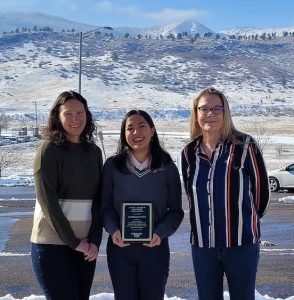
2022 David L. Dietrich Honorary Scholarship Award: Air Resource Specialists Vice President Jessica Ward, Gabrielle “Bee” Leung (recipient), and Sue van den Heever (adviser).
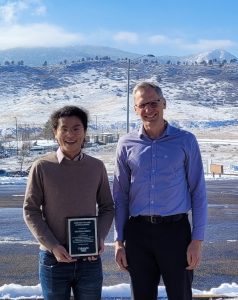
2022 Shrake-Culler Scholarship Award: Wei-Ting Hsiao (recipient) and Eric Maloney (adviser).
Students receiving the Dietrich Scholarship have demonstrated outstanding research and education in air quality.
Sue, who nominated Bee for the Dietrich award, cited her for “very novel and extensive work in aerosol cloud interactions and their implications for air quality” that is contained within three first-author publications and four other papers. Sue noted that Bee’s work has implications for air quality, clouds and precipitation processes around urban regions, smoke plumes, and over tropical maritime and continental regions. The Dietrich Scholarship is funded by Fort Collins-based Air Resource Specialists Inc. each year in honor of retired ARS President David Dietrich.
The Shrake-Culler Scholarship is given annually to a senior Ph.D. student who has passed their preliminary exam, has a GPA of 3.5 or above, and has demonstrated a strong work ethic and enthusiasm for higher education.
Wei-Ting was cited by Eric Maloney as advisor for his work ethic as typified by four first author publications, participation in the PRECIP field campaign, and leadership in the governance of the Atmospheric Science International Student and Scholar Association, among other duties. Wei-Ting has demonstrated excellence in education through his role as TA in ATS 150, the Science of Climate Change, where he developed extensive course content and provided well-received course lectures, in addition to his other duties as TA. Wei-Ting generally studies tropical meteorology, climate dynamics, and subseasonal prediction.
Congratulations Bee and Wei-Ting! The Department is proud and privileged that you are part of ATS.
Top photo: Group photo of both award recipients and their advisers. Eric Maloney (adviser), Wei-Ting Hsiao (Shrake-Culler recipient), Gabrielle “Bee” Leung (Dietrich recipient), and Sue van den Heever (adviser).